
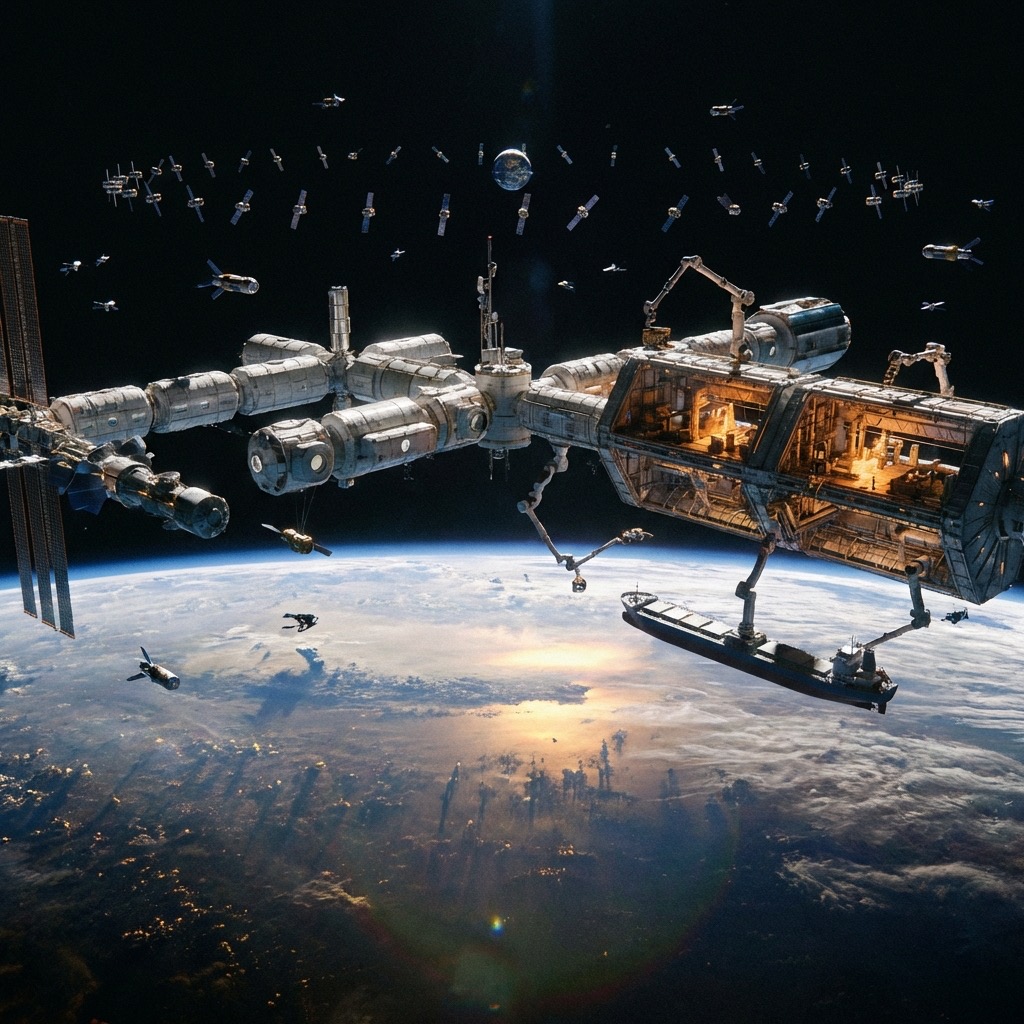
Low Earth Orbit (LEO) is Open for Business
Space is no longer the domain of superpowers. In 2026, the "New Space" economy is booming, driven by reusable rockets and shrinking satellites.
- Satellite Constellations: Companies like SpaceX (Starlink) and Amazon (Kuiper) have blanketed the Earth with broadband internet. This is changing the topology of the internet itself, bringing high-speed fiber-like connectivity to the middle of the ocean or the Sahara desert.
- Earth Observation: Planet Labs and other startups are imaging the entire Earth constantly. This data feeds AI models for analyzing crop health, monitoring illegal fishing, or counting oil reserves in tanks by measuring shadows.
In-Space Manufacturing
Why make things in space? Microgravity. Crystals grow larger and purer without gravity. Fiber optic cables (ZBLAN) drawn in space have significantly less signal loss than those made on Earth. We are seeing the first unmanned factories orbiting Earth, printing organs (bioprinting) or ultra-efficient semiconductors, then dropping the finished products back down in reentry capsules.
Computing in Orbit
Traditionally, satellites were "dumb" data collectors that sent raw data to ground stations. Now, we have Edge Computing in Space. Satellites equipped with powerful GPUs process images on-board (e.g., detecting a forest fire) and send only the alert down to Earth, reducing response time from hours to seconds.
Conclusion
The space economy is projected to reach $1 trillion by 2030. It is the ultimate high-ground for connectivity, data, and manufacturing.