
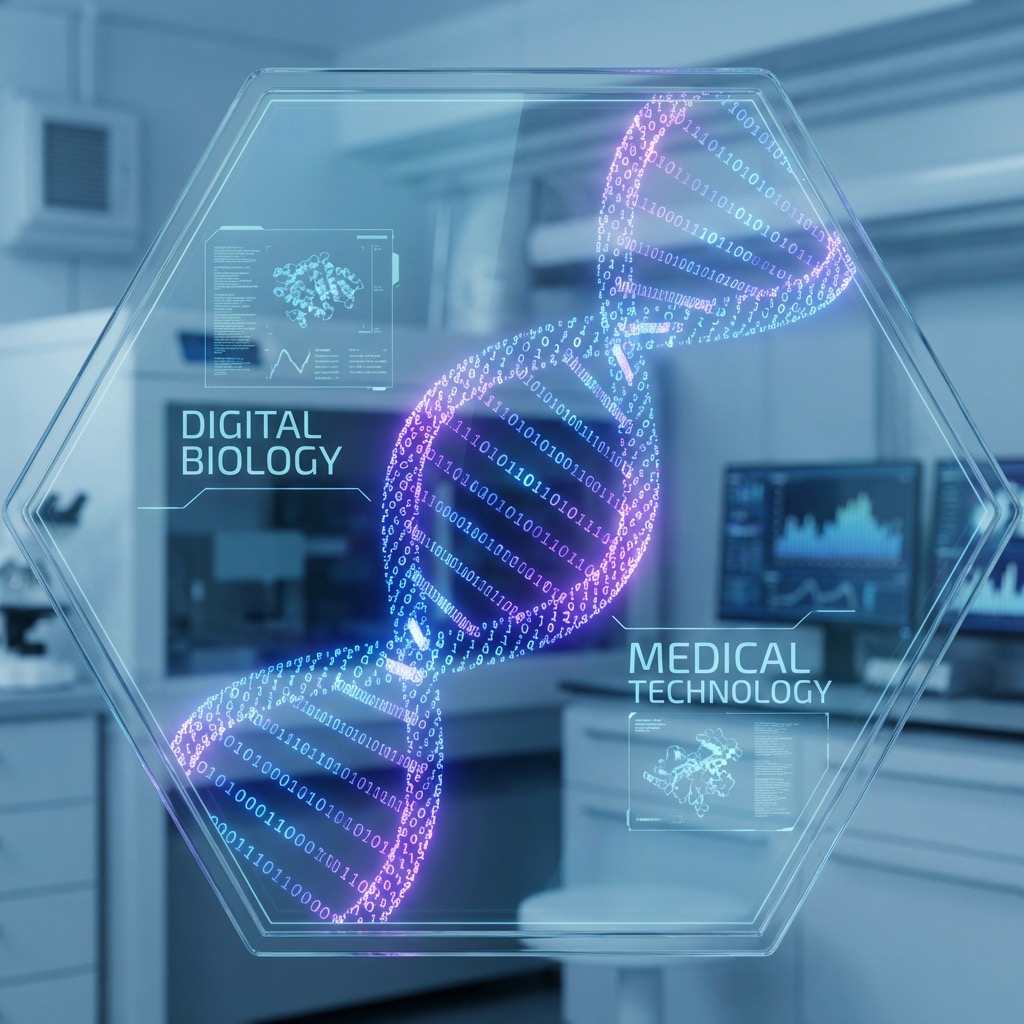
Biology is becoming an Information Science
The cost of sequencing a human genome has fallen from $100 million in 2001 to under $100 today. This overflow of data has birthed Bioinformatics—the application of computer science to understand biological data. In 2026, we are not just reading DNA; we are compiling it.
Proteomics and AlphaFold
While Genomics (DNA) is the blueprint, Proteomics (Proteins) is the machinery. Google DeepMind's AlphaFold was the "Sputnik moment" for biology, solving the 50-year-old "protein folding problem" by predicting 3D structures from amino acid sequences. Today, drug discovery is simulation-first. Instead of testing chemicals in a wet lab for years, algorithms simulate how millions of molecules engage with a disease target, shortlisting the best 10 for physical testing.
Personalized Medicine
The "one size fits all" era of pills is ending. If you have cancer, doctors can now sequence your tumor's specific mutations. Bioinformatics pipelines compare these mutations against global databases to recommend a targeted therapy that kills the cancer cells while sparing healthy ones. This "Pharmacogenomics" ensures that patients don't waste time on drugs that their specific metabolism cannot process.
The Data Challenge
A single human genome is about 200GB of raw data. A hospital generates petabytes per year. Storing, compressing, and securing this data (which cannot be anonymized—your DNA is you) is a massive challenge for cloud architects.
CRISPR and Gene Editing
We are moving from "Read-Only" biology to "Read-Write". CRISPR technology allows precise editing of DNA sequences. Bioinformatics software designs the "guide RNA" to ensure the cut happens exactly at the disease-causing mutation and nowhere else (off-target effects).
Conclusion
Bioinformatics is the frontier where code meets flesh. It promises a future where diseases are treated as bugs in the source code of life, debugged and patched by the combined power of supercomputers and biological engineers.