
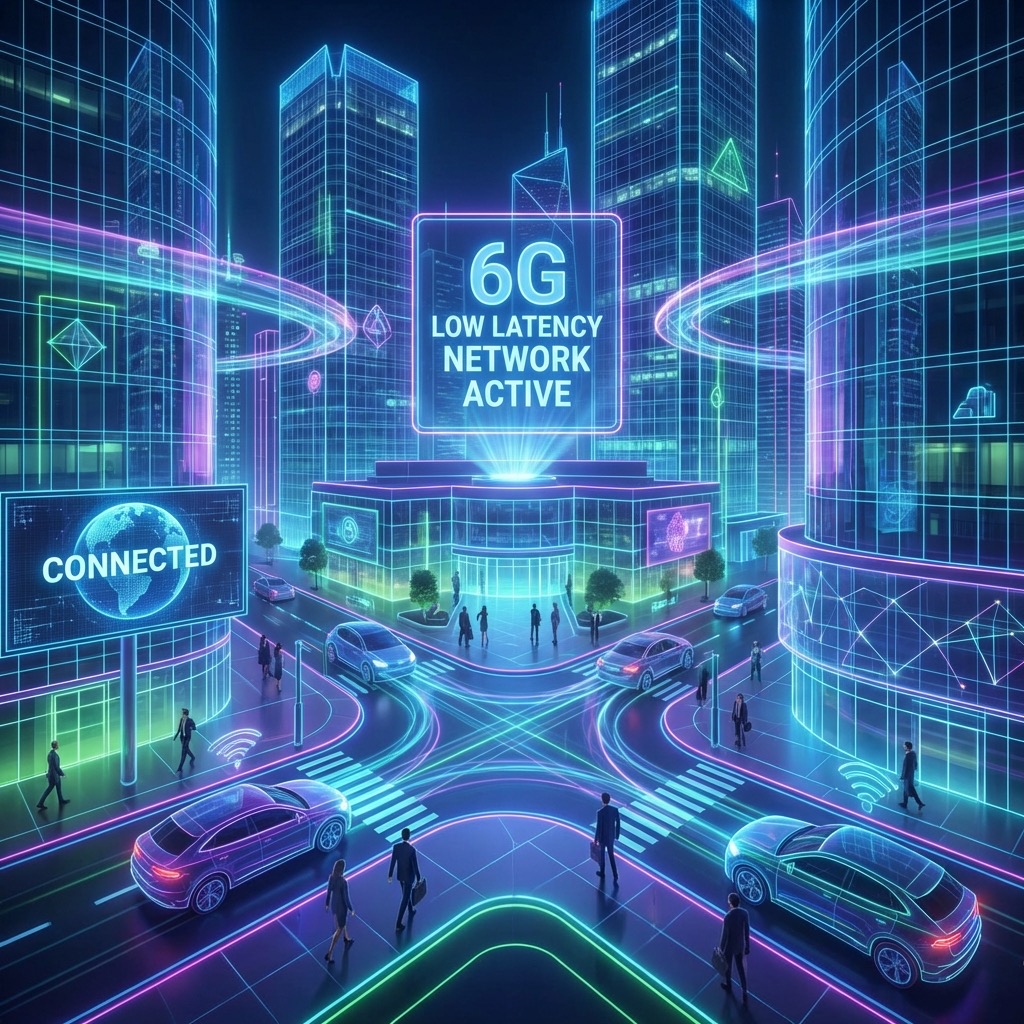
Beyond the Cloud: The Rise of the Edge
For the past 15 years, the dominant trend in IT has been "Cloud First"—centralizing data in massive data centers. However, as we approach 2026, the pendulum is swinging back. We are entering the era of "Edge First," driven by applications that cannot tolerate the 50-100ms round-trip latency to a centralized cloud. Edge Computing brings processing power closer to where data is generated—on the factory floor, in the autonomous vehicle, or at the 5G tower.
Why Speed Matters
In the world of AI and IoT, milliseconds matter.
- Autonomous Vehicles: A self-driving car generates terabytes of data per hour. It cannot wait to upload a video frame to a data center to decide if the object in front of it is a pedestrian or a plastic bag. That decision must happen on-board (Extreme Edge) or at the nearest cell tower (Network Edge).
- VR/AR: For the Metaverse or Industrial AR to feel "real," the motion-to-photon latency must be under 20ms. Cloud rendering is simply too slow due to the speed of light.
Enter 6G: The Neural Nervous System
While 5G was about bandwidth (downloading movies faster), 6G (expected to launch commercially around 2028-2030, but seeing pilot tests in 2026) is about latency and sensing. Key 6G capabilities:
- Sub-millisecond Latency: Enabling true tactile internet (telesurgery).
- Integrated Sensing and Communication (ISAC): 6G networks won't just carry data; they will act as radar. A 6G Wi-Fi router could detect a person falling in a room by analyzing how the radio waves bounce, without needing a camera.
The New Architecture: Fog Computing
We are moving to a 3-tier architecture:
- Cloud: Deep learning training, archival storage, big data analytics.
- Fog/Edge: Real-time interference, local caching, immediate decision making.
- Device: Sensors and actuators.
Applications are becoming "continuum-aware," enabling them to dynamically move microservices between these layers based on network conditions and battery life.
Challenges
- Security: Securing 10 massive data centers is hard. Securing 10 million edge nodes (which can be physically tampered with) is a nightmare. Zero Trust must be absolute.
- Orchestration: Kubernetes is great for the cloud, but K3s or KubeEdge must manage workloads across flaky, intermittent connections.
Conclusion
The combination of Edge AI and 6G connectivity will effectively make the internet "invisible." We won't "go online"; the environment around us will be intelligent, responsive, and immediate.